
Nokona CM275K Closed Web Buckaroo Hide Catcher’s Mitt (32.5-Inch)

$249.95

Make sure this fits by entering your model number.
32.5″ Premier Softball Catchers Mitt
Premium Walnut Palm and Kangaroo Back

Description

Product Description

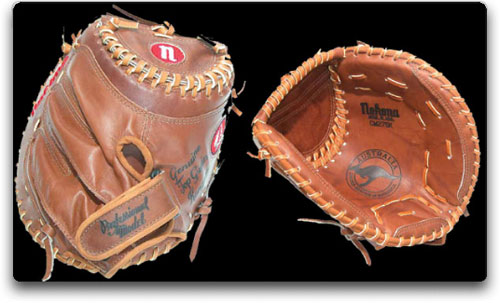
32.5″ catcher mitt with buckaroo walnut cowhide palm and kangaroo leather back. Kangaroo leather is one of the finest and strongest lightweight leathers known. Its tensile strength far exceeds that of other animals. The fine texture gives the player a glove that will break-in quickly and the light weight for those who prefer a lighter weight glove. The walnut cowhide leather gives the glove the added support for retaining its shape.

Amazon.com

The 32.5-inch Nokona CM275K softball catcher’s mitt is designed specifically for elite players looking for a professional quality mitt. It’s made of kangaroo leather and features closed webbing, Sure Pull Strap (made of Velcro for easy adjustment), double break pocket, and a pocket measurement of 13 by 14 inches (HxW). Kangaroo leather is one of the finest and strongest lightweight leathers, with a tensile strength far exceeding that of other animals. The fine texture gives the player a glove that will break-in quickly and the light weight is great for those who prefer a lighter glove. The walnut cowhide leather palm gives the glove the added support for retaining its shape. It’s backed by a one-year warranty. Made in the USA.
About Nokona
Originally known as the Nocona Leather Goods Company and based in Nocona, Texas, Nokona had to change the spelling of its name when the U.S. patent office wouldn’t allow the name of the town to be trademarked. Founded in 1926, Nokona employs highly skilled local leather crafters to create its tradition of creating handmade leather baseball gloves, which are used by countless professional athletes around the world.

P.when(‘A’).execute(function(A) { A.on(‘a:expander:toggle_description:toggle:collapse’, function(data) { window.scroll(0, data.expander.$expander[0].offsetTop-100); }); });

Buying Guide

Amazon.com Baseball and Softball Glove Guide
Playing the Field
Baseball and softball gloves are specially designed to suit the needs of a given field position, with each style of glove boasting unique features to improve a player’s performance at his or her position. The following is a brief summary of each glove’s characteristics:

  • Catcher: No finger channels, with heavy palm padding and overall reinforcements to reduce the sting of repeatedly catching pitchers’ throws
  • First Base: Also lacks finger channels, but with less padding that a catcher’s mitt, with added length to help catch infield throws and shallow pocket, enabling quick ball retrieval
  • Infield: Five-fingered glove has shallow pocket for fast ball retrieval, with nine- to 10-inch youth sizes and 10.5- to 11.5-inch adult sizes, and softball infield gloves having a deeper pocket to accept the larger ball
    • Second base players require smaller gloves to balance control with the need to make quick throws
    • Shortstops use a mid-sized glove for ground balls and quick throws
    • Third base players need a larger glove for maximum catching power
  • Outfield: Glove is longer to provide extended reach, with a deep pocket to handle high-lofting balls, and sizes range from 12 inches and up for adults and 11 inches for youth players
  • Softball Gloves: The characteristics, by position, of softball gloves are typically similar to their baseball counterparts, with softball gloves having more length and deeper pockets to handle the larger ball

Anatomy of a Glove
Gloves are designed to perform a relatively simple task–catch a ball. The quality of materials and craftsmanship that can go into a building a glove, however, can be surprising. Below is an overview of a glove’s components and how each helps optimize your defensive game:

  • Pocket: Pocket depth is determined by player position, with shallower pockets helping infielders quickly retrieve and throw the ball, and outfielders’ pocket depth aiding in capturing a ball on the fly. Softball players also need deeper pockets to catch the larger ball.
  • Webbing: The preferred webbing pattern is partly determined by field position and partly by player preference. Generally, open webbing helps infielders quickly retrieve the ball, closed or tightly woven webbing gives outfielders and third basemen extra support, and closed webbing allows pitchers to hide the ball from the batter.
  • Backs: The back of a glove, or the part that goes across the top of your hand, can either be closed or open, which is largely a matter of player preference. Some infielders find an open back to be more flexible and forgiving, while outfielders may like a closed back with finger hole for added support.
  • Wrist Adjustment: Some gloves include fit systems, or wrist adjustments, to help keep the glove tightly affixed to a player’s hand. The most popular closures are buckles, D-rings, lacing, and Velcro.
  • Padding: How padded a glove’s pocket is depends on position, with catcher being the most heavily padded. In recent years, many manufacturers have begun to add padding to other position gloves to reduce “palm shock.”
  • Materials: By and large, gloves are constructed using one of three materials–leather, treated leather, or synthetic–with the differences relating to feel and durability.
    • Leather: Most high-end gloves are made of leather, which offers optimal feel and durability, with leather quality being a significant cost driver
    • Treated Leather: Leather material is softened and strengthened during production for quicker break-in, better durability, and lower maintenance
    • Synthetic: A lower-cost alternative to leather that offers reduced durability and responsiveness, and is a good option for beginning players

Fits Like a…
As mentioned above, age and position are the most significant factors in selecting a proper glove size. Outfielders need larger gloves with deeper pockets for maximum “catchability,” while infield gloves are smaller and have shallower pockets for optimal control and speedy ball removal. Some pitchers opt for infield gloves that are slightly larger than standard, yet small and shallow enough for rapid fielding and throwing. Most younger players will benefit from youth-sized gloves that help with control, and it’s a good idea to resist the temptation to buy a larger glove the child will grow into.

The tables below offer a general guideline for proper glove size by sport, position, and age.

Baseball Glove Size
AgePositionGlove Size
Under 8Infield9″
Under 8Outfield11″
9-13Infield9-10″
9-13Outfield11-12″
13 and olderInfield10.5-11.5″
13 and olderOutfield12-12.75″
Softball Glove Size
AgePositionGlove Size
6 and underAll9-10″
7-9All10-11.5″
10-14Infield11.5-12.5″
10-14Outfield12-13″
15 and olderInfield12-13″
15 and olderOutfield12.5-14″

See more

Make sure this fits by entering your model number.
32.5″ Premier Softball Catchers Mitt
Premium Walnut Palm and Kangaroo Back
Closed Web With Sure Pull Strap
Double Break Pocket Design
For Softball

Additional information

Brand

Reviews

There are no reviews yet.

Only logged in customers who have purchased this product may leave a review.